
Showing posts with label extraordinary form. Show all posts
Showing posts with label extraordinary form. Show all posts
Friday, 15 April 2011
Bring back the Feast of the Seven Dolours of the Blessed Virgin Mary!

Wednesday, 9 March 2011
To wipe off or not to wipe off, that is the question
I decided to keep the ashes on my forehead until I arrived at uni this morning. I'd arrived early and so I was sitting in a computer lab diligently getting on with one of the many "I should have done this earlier" tasks. Anyway, I thought I had class an hour earlier than I did, so I went to the room, realised no one was there and that I was too early and so promptly returned to the Languages building. Outside I saw a friend who came up to me, noticed the ashes on my forehead and gave a comical inquisitive look at my forehead and said, "you have a really dirty forehead by the way". I realised I couldn't cope with the attention, gave a brief explanation and then went and scrubbed it off reverently, remembering that the ash itself is a sacramental. Knowing my personality and the people at uni, keeping the ash on would be worse. It depends on the circumstance, I think.
Anyway, I LOVE the Latin expression "Memento, homo, quia pulvis es, et in pulverem reverteris", particularly the bit at the end with all the Es and Rs. With a nice rolled R it sounds great and ominous, like all memento moris should be.

Anyway, I LOVE the Latin expression "Memento, homo, quia pulvis es, et in pulverem reverteris", particularly the bit at the end with all the Es and Rs. With a nice rolled R it sounds great and ominous, like all memento moris should be.
Christ preaching repentance, for the Kingdom of God is at hand.
Wednesday, 19 January 2011
When the cat's away...
... the mice will try and go to the EF of Mass in Edinburgh. Or at least that's what my younger brother's hoping. As soon as he found out the parental units will be away, leaving us under adelphacratic rule, he asked if we could go to another TLM in Ravelston. Let's see...
Tuesday, 18 January 2011
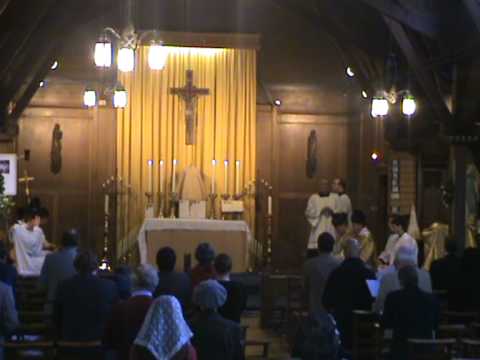
A Snapshot of Life Living Close to a Daily TLM
Nantes.
Wrapped up warm in my navy blue jacket with a detachable fleece inside (two coats for the price of one!), I set off for the tram stop Recteur Schmidt (really make the R as guttural as possible in Recteur). Waiting at the tram stop were some other students, mostly on my side, heading into the centre of Nantes. Getting on at the back (where there's usually more room), I looked around in vain for a seat. Never mind - it was more important that I was near the door for getting off, as the trams could get really busy at 5.30.
Jolted out of my reverie by the cheery announcement of "Saint Mihiel" (which I always thought sounded like she was saying "Holy Honey"), I squeeze past the young black woman with the huge handbag and the old biddie with the tons of shopping, repeating "Pardon!" the whole time. I really couldn't seem to lose that British way of apologising profusely for my existence.
Wrapped up warm in my navy blue jacket with a detachable fleece inside (two coats for the price of one!), I set off for the tram stop Recteur Schmidt (really make the R as guttural as possible in Recteur). Waiting at the tram stop were some other students, mostly on my side, heading into the centre of Nantes. Getting on at the back (where there's usually more room), I looked around in vain for a seat. Never mind - it was more important that I was near the door for getting off, as the trams could get really busy at 5.30.
Jolted out of my reverie by the cheery announcement of "Saint Mihiel" (which I always thought sounded like she was saying "Holy Honey"), I squeeze past the young black woman with the huge handbag and the old biddie with the tons of shopping, repeating "Pardon!" the whole time. I really couldn't seem to lose that British way of apologising profusely for my existence.
Sunday, 14 November 2010
Reminiscing of the days in Nantes
Today I watched a video that featured on the website of the FSSP parish in Nantes, which is by far the best parish I have EVER been to. Here is the video, which looks back over the past year at the parish. Almost all of the events featured took place after I left, but what you can gather from the video is that it is a truly "living" parish, dedicated to forming young peoples lives so that they are well-rounded and properly equipped to deal with the vicissitudes of life, if you pardon the cliché, and also to preach the gospel by their way of living. It is entirely contrary to the popular yet gravely dishonest caricature of being sour and grumpy folk that traditionalists are often portrayed as. No, theirs is a parish where one cannot help but notice the love of Christ acted out in its members' devotion. The two priests were also excellent confessors and I can say that my time there was the most spiritually consoling and helpful time in my life. Oh how I miss it!
Monday, 16 August 2010
My brother's experience of the Extraordinary Form
Today my brother and I went to the local FSSP church in Edinburgh for the Feast of the Assumption. After sitting on a bus for over an hour and doing that awkward walk which you do when you think you are late but don't want to run, we arrived at the church, walking in hurriedly and then suddenly having two booklets and two sheets handed to us.
We walked across and remained in the very back corner throughout Mass and I pointed out where we were every now and then to my brother. For me, the Mass was like a usual EF Mass, more akin to the one I went to in Germany than the one in France (the one in France was much larger, was packed and had a little more solemnity to it - more of a Cathedral feel to it). It was similar to Germany in another aspect - in Germany a non-Christian friend of mine who was interested had been coming along to church with me, both to the OF and the EF when it was on. As I knew she had no background of Christianity whatsoever, I found myself anxious in case she was totally lost and clueless to what was going on. Well, this anxiety returned a little today.
My brother seemed aloof to a lot of what was going on although when quizzed afterwards it turned out he had taken much more in than I'd thought. I then asked him what he liked and disliked.
First of all, what he wasn't so keen on:
Anyway, overall he seemed quite positive though he's not desperate to go back. Plus, we've got our local parish to keep alive anyway.
We walked across and remained in the very back corner throughout Mass and I pointed out where we were every now and then to my brother. For me, the Mass was like a usual EF Mass, more akin to the one I went to in Germany than the one in France (the one in France was much larger, was packed and had a little more solemnity to it - more of a Cathedral feel to it). It was similar to Germany in another aspect - in Germany a non-Christian friend of mine who was interested had been coming along to church with me, both to the OF and the EF when it was on. As I knew she had no background of Christianity whatsoever, I found myself anxious in case she was totally lost and clueless to what was going on. Well, this anxiety returned a little today.
My brother seemed aloof to a lot of what was going on although when quizzed afterwards it turned out he had taken much more in than I'd thought. I then asked him what he liked and disliked.
First of all, what he wasn't so keen on:
- sometimes the chant went on for a little too long - he was thinking particularly of the "alleluiaaaaaaaaaaaa"
- he missed a hymn sometimes
- not seeing what the priest was doing (though he blames this on our position at the very back behind a pillar)
- he lost his place a lot and found it hard to follow
- the Gospel being sung
- the annoying moth (ok, this was nothing to do with the actual Mass, I know)
- everyone was appropriately dressed
- nobody talking
- appropriate reverence
- lack of hand-shaking
- trained altar servers
- the organ
- no requirement to sing
Anyway, overall he seemed quite positive though he's not desperate to go back. Plus, we've got our local parish to keep alive anyway.
Friday, 13 August 2010
Mass for the Assumption in the Extraordinary Form
This Sunday, I plan to go to the local FSSP church in Edinburgh for the Assumption. I also plan on taking my brother along and it will be his first time assisting at a TLM. I'll post an update afterwards commenting on how my brother found the Mass.
Wednesday, 26 May 2010
Pro seipso sacerdote
I read this great post by the incomparable Father Z today on the prayers that the priest said for himself on the anniversary of his ordination. The first mentioned are those of the extraordinary form of the Roman Rite. They emphasise the humility of the priest as a servant to all, above all to God, who in His mercy established the priesthood. The post speaks for itself so I'll just post it all here.
In the traditional, Extraordinary Form a priest can add orations for the anniversary of his ordination, Pro seipso sacerdote.
The 2002MR has three formularies Pro seipso sacerdote while the 1962MR has but one.
Since this is a time of year when new priests are being ordained, and many priests are observing their own anniversaries, let’s have a WDTPRS look at the prayers Pro seipso sacerdote from the traditional, Extraordinary Form.
COLLECT (1962MR):
Omnípotens et miséricors Deus,
humilitátis meae preces benígnus inténde:
et me fámulum tuum, quem,
nullis suffragántibus méritis,
sed imménsa cleméntiae tuae largitáte,
caeléstibus mystériis servíre tribuísti,
dignum sacris altáribus fac minístrum;
ut, quod mea voce deprómitur,
tua sanctificatióne firmétur.
SLAVISHLY LITERAL VERSION:
Almighty and merciful God,
kindly hark to the prayers of my humility:
and make me, Your servant, whom,
no merits of my own favoring me,
but by the immense largess of your indulgence,
You granted to serve the heavenly mysteries,
to be a worthy minister at the sacred altars;
so that, that which is called down by my voice,
may be made sure by Your sanctification.
The prayer focuses on priest’s self-awareness of his lowliness and that who he is and what he does is from God’s grace and choice and not his own.
It also emphasis the relationship of the priest to the altar, that it, the bond of the priest and Holy Mass. In the older form of Holy Mass, after the consecration during the Canon at the Suppplices te rogamus... the priest bends low over the altar, puts his hands on it… they were annointed, the altar was annointed… kisses the altar, makes the sign of the Cross over the consecrated Host on the corporal, over the Precious Blood in the chalice, over himself. Christ is Victim. Christ is Priest. The priest is victim and priest as well. This moment during Holy Mass reveals the mysterious bond of altar where the priest sacrifices the victim, the sacrificial victim and the sacrificing priest. They are one. At the altar he is alter Christus, another Christ, offering and offered.
What also comes to mind as I look at this is the Augustinian reflection of the speaker of the Word and the Word spoken, and the message and reality of the Word and the Voice which speaks it. The voice of the priest and the priest himself are merely the means God uses in the sacred action, the sacramental mysteries at the altar, to renew in that moment what He has wrought. Finally, this is done through mercy. The words misericors, clementia, largitas, benignus all point to the mercy of God.
The priest speaks and God makes what he speaks reality. He takes the insubstantial words and makes them firm and real. How important it is for the priest to get himself out of the way when he is at the altar, where the True Actor is in action, Christ the Eternal and High Priest.
SECRET (1962MR):
Huius, Dómine, virtúte sacraménti,
peccatórum meórum máculas abstérge:
et praesta;
ut ad exsequéndum injúncti offícii ministérium,
me tua grátia dignum effíciat.
SLAVISHLY LITERAL VERSION:
O Lord, by the power of this sacrament,
cleanse the stains of my sins:
and grant;
that it may make me worthy by Your grace
unto the performance of the ministry of the office that has been imposed.
Priests are sinner in need of a Savior just like everyone else. They confess sins and receive absolution like everyone else. They, to, must do penance for past sins like everyone else. They come to the altar as sinners. In the older form of Holy Mass, the texts of the ordinary constantly remind the priest of who he is and who he isn’t. In this Secret, spoken quietly, the priest prays for what only God can do: remove the stains of sins from his soul.
The prayer brings also to mind the burden of the yoke of the priesthood, symbolized as by the priestly vestment, the chasuble. As the priest vests he says as he puts on this vestment, "O Lord, Who said: My yoke is easy and My burden light: grant that I may bear it well and follow after You with thanksgiving. Amen." The yoke is the ancient sign of subjugation. The ancient Romans caused the conquered to pass under a yoke, iugum.
POSTCOMMUNION (1962MR):
Omnípotens sempitérne Deus,
qui me peccatórem sacris altáribus astáre voluísti,
et sancti nóminis tui laudáre poténtiam:
concéde propítius, per hujus sacraménti mystérium,
meórum mihi véniam peccatórum;
ut tuae majestáti digne mérear famulári.
SLAVISHLY LITERAL VERSION:
Almighty eternal God,
who desired me, a sinner, to stand at the sacred altars,
and to praise the might of Your Holy Name:
propitiously grant, through the mystery of this sacrament,
the forgiveness of my sins for me;
so that I may merit to wait upon Your majesty.
On the day of ordination the priest lies down upon the floor.
He becomes the lowest thing in the church.
As I read this, I am struck by the two sets of contrasts.
First, there is the contrast of the low state of the servant sinner and the majesty of God.
Second, there is the present moment contrasted with the future to come.
Majestas is like gloria, Hebrew kabod or Greek doxa, a divine characteristic which – some day – we may encounter in heaven in such a way that we will be transformed by it forever and forever. When Moses encountered God in the cloud on the mountain and in the tent, he came forth with a face shining so brightly that he had to wear a veil. This is a foreshadowing of the transformative power of God’s majestas.
A priest waits on this majestas. He awaits it and waits upon it. He desires it for his own future, but in the present moment he waits upon it as a servent. He is an attendent, in every sense, one who waits and one who waits.
May God have mercy on priests, sinner servants, attendent on the unmerited grace and gifts of the Victim Priest and Savior.
Consider the mercy of God in His gift of the priesthood during these last days of the year of the priest.
The feast of Corpus Christ this year falls on the first Thursday of June, the last day lay people can gain a plenary indulgence by praying for priests in this Year of the Priest.
Tuesday, 20 April 2010
Good Shepherd Sunday
Last Sunday I went to the Extraordinary Form of the Mass for the first time since I arrived here in Heidelberg. And I must say that it was excellent. It was held in a relatively small church somewhat linked within the same Gemeinde or Seelsorgeeinheit as the Jesuitenkirche, in the same church where the only regular confession times are held and the only place for Eucharistic Adoration (the St. Anna Kirche that I mentioned in a previous post - clearly the orthodox place to be).
The mass started with an announcement of the fact that it was the 5th anniversary of the Holy Father's pontificate, and as a consequence, we would be singing and praying the Oremus pro Pontifice for the occasion. And thereafter Holy Mass proceeded. It was actually quite different from the Masses I went to in Nantes, where everyone was so clearly used to the EF, but here, where the small church was quite restrictive, it was perhaps less smooth. Nevertheless, they definitely managed it well. They had a "choir" of two men who could really belt out a tune and were perfect for the size of the church. The priest had a capable singing voice and his homily was the best homily I've probably heard here in Heidelberg. It was a very appropriate occasion to be talking of the Good Shepherd, where His vicar on earth is currently under much attack. I found the Oremus pro Pontifice entirely appropriate and beautiful.
Unfortunately, Holy Mass in the EF is nowhere near as common as in Nantes, and I believe the next one is in two weeks. The only other problem is that it is in the evening, which I really do not like, as I do not know what to do in the morning.
Here is the text of Oremus pro Pontifice:
V.Oremus pro Pontifice nostro Benedicto.
R. Dominus conservet eum, et vivificet eum, et beatum faciat eum in terra, et non tradat eum in animam inimicorum eius.
Pater noster. Ave Maria.
Deus, omnium fidelium pastor et rector, famulum tuum N., quem pastorem Ecclesiae tuae praeesse voluisti, propitius respice: da ei, quaesumus, verbo et exemplo, quibus praeest, proficere: ut ad vitam, una cum grege sibi credito, perveniat sempiternam. Per Christum, Dominum nostrum. Amen.
V. Let us pray Benedict, our Pope.
R. May the Lord preserve him, and give him life, and make him blessed upon the earth, and deliver him not up to the will of his enemies.
Our Father. Hail Mary.
O God, Shepherd and Ruler of all Thy faithful people, look mercifully upon Thy servant N, whom Thou hast chosen as shepherd to preside over Thy Church. Grant him, we beseech Thee, that by his word and example, he may edify those over whom he hath charge, so that together with the flock committed to him, may he attain everlasting life. Through Christ our Lord. Amen.
The mass started with an announcement of the fact that it was the 5th anniversary of the Holy Father's pontificate, and as a consequence, we would be singing and praying the Oremus pro Pontifice for the occasion. And thereafter Holy Mass proceeded. It was actually quite different from the Masses I went to in Nantes, where everyone was so clearly used to the EF, but here, where the small church was quite restrictive, it was perhaps less smooth. Nevertheless, they definitely managed it well. They had a "choir" of two men who could really belt out a tune and were perfect for the size of the church. The priest had a capable singing voice and his homily was the best homily I've probably heard here in Heidelberg. It was a very appropriate occasion to be talking of the Good Shepherd, where His vicar on earth is currently under much attack. I found the Oremus pro Pontifice entirely appropriate and beautiful.
Unfortunately, Holy Mass in the EF is nowhere near as common as in Nantes, and I believe the next one is in two weeks. The only other problem is that it is in the evening, which I really do not like, as I do not know what to do in the morning.
Here is the text of Oremus pro Pontifice:
V.Oremus pro Pontifice nostro Benedicto.
R. Dominus conservet eum, et vivificet eum, et beatum faciat eum in terra, et non tradat eum in animam inimicorum eius.
Pater noster. Ave Maria.
Deus, omnium fidelium pastor et rector, famulum tuum N., quem pastorem Ecclesiae tuae praeesse voluisti, propitius respice: da ei, quaesumus, verbo et exemplo, quibus praeest, proficere: ut ad vitam, una cum grege sibi credito, perveniat sempiternam. Per Christum, Dominum nostrum. Amen.
V. Let us pray Benedict, our Pope.
R. May the Lord preserve him, and give him life, and make him blessed upon the earth, and deliver him not up to the will of his enemies.
Our Father. Hail Mary.
O God, Shepherd and Ruler of all Thy faithful people, look mercifully upon Thy servant N, whom Thou hast chosen as shepherd to preside over Thy Church. Grant him, we beseech Thee, that by his word and example, he may edify those over whom he hath charge, so that together with the flock committed to him, may he attain everlasting life. Through Christ our Lord. Amen.
Sunday, 14 March 2010
Confession in Heidelberg
Last night I went to Confession for the first time here in Germany. I had been really frustrated, however, because there seems to be only one hour of confession time a week offered here in the whole of Heidelberg. It was at St Anna's, where they were also holding Eucharistic adoration. Offering Confession at the same time as adoration is a very good idea, as when we are confronted with God, He helps us in our preparation before confession and then after Confession, we can say our thanksgiving before Him Who has just forgiven us.
This same Church also offers the Extraordinary Form of the Mass on Sunday evenings, which doesn't surprise me. Generally, if a Church offers Adoration time, they're more likely to offer the EF too (and this Church also seems to be the only one offering Confession regularly as well).
St Anna's is part of the Heiliggeistgemeinde, or Holy Spirit Parish, which also includes the famous Jesuitenkirche. The Jesuitenkirche played a fair role during the reformation, and although it is now the main church in Heiliggeistgemeinde, the Heiliggeistkirche used to be part of this Gemeinde too, before it was captured, recaptured, split in two (by a partition wall, not structurally!) and then finally given over to the Protestants (the church is evangelisch, which would be better translated as protestant rather than evangelical, as the latter is evangelikal. Furthermore, the Evangelical Church of Germany is a mixed bag of Lutheran, Anglican and Reformed churches, so I would need to go to a service to find out which exact denomination it is, or do a little more research). More to come, such as photos!
This same Church also offers the Extraordinary Form of the Mass on Sunday evenings, which doesn't surprise me. Generally, if a Church offers Adoration time, they're more likely to offer the EF too (and this Church also seems to be the only one offering Confession regularly as well).
St Anna's is part of the Heiliggeistgemeinde, or Holy Spirit Parish, which also includes the famous Jesuitenkirche. The Jesuitenkirche played a fair role during the reformation, and although it is now the main church in Heiliggeistgemeinde, the Heiliggeistkirche used to be part of this Gemeinde too, before it was captured, recaptured, split in two (by a partition wall, not structurally!) and then finally given over to the Protestants (the church is evangelisch, which would be better translated as protestant rather than evangelical, as the latter is evangelikal. Furthermore, the Evangelical Church of Germany is a mixed bag of Lutheran, Anglican and Reformed churches, so I would need to go to a service to find out which exact denomination it is, or do a little more research). More to come, such as photos!
Tuesday, 26 January 2010
More photos of the two priests
Here are some more photos of the two FSSP priests, Messieurs les abbés Jouachim and Roseau.


In this one, Jouachim is priest and Roseau is deacon.


Here one of Abbé Roseau's self-made hosts is being consecrated.

De pænultima die
I've just come back from my last EF Mass here in Nantes, that of the feast of St Polycarp, so the priest, the fantastic Abbé Roseau, was wearing beautiful red vestments.
Being the shy soul that I am, I had never really introduced myself to the priests or indeed anyone at the parish. It was only last week that someone approached me whom I'd met before. They had no idea I attended the EF on such a regular basis (my attendance has been pretty much daily over the past two weeks). However, I leave Nantes on Thursday so the man and the woman whom I knew invited me to lunch after Mass on Sunday. What a delightful Sunday it was. It was so peaceful that it really pained me to think that I'd only have one such Sunday, and that this won't happen again.

I am so grateful to the priests at the parish and I thank God for them, Abbé Roseau and Abbé Jouachim. I could not leave without expressing this gratitude and so I bought a card, bearing the name St Clément (the name of the church) and wrote a sentence or two (in French of course) expressing my thanks to them for these my first experiences at the EF of the Mass. My original intention was to just leave it lying there on one of the tables at the back of the Church under the noticeboard but then I decided I would hand it to M. l'abbé Roseau personally for several reasons. Firstly, the card could lie there for weeks without anyone noticing. Secondly, it could be picked up by someone else. Thirdly, even if they did get the card, they would probably have no idea who I am, and would probably just seem rather strange. And finally, I don't think it would truly express my gratitude if I just left it lying for them, rather than actually having a conversation with them. So I waited until the priest heard a few Confessions and finished his prayers, and then approached him. I think he did recognise me, and if he didn't immediately, he will have recognised the same voice who stumbles through confessions in awkward French, often not making much sense. I gave him the card and he inquired as to what it was, and then I told him that I was leaving Nantes. He asked a few more questions and then just as I was going out of those thick double doors one finds in churches to keep the heat in, he said he would like to give me a blessing for my travels. It was totally unexpected but I really felt like this is what it must be like to live in a country which still has some dregs of a Catholic culture. In Scotland, I often feel as though we are just meant to be grateful that the Church is allowed to operate in such a presbyterian country, and so never mind all these traditions such as blessings, churching of women, house blessings and the like. So finally, I'd like to thank God for the thousands of opportunities He has given me while here in Nantes, and I am ever so grateful to Him.
Benedictus Jesus Christus, verus Deus et verus homo. Benedictum Cor ejus sacratissimum!

(Abbé Roseau also has a blog describing his journey on making his own hosts for Mass. You can find it here. I've also already posted a link to the Nantes FSSP website where you can see the two priests in action.)
Being the shy soul that I am, I had never really introduced myself to the priests or indeed anyone at the parish. It was only last week that someone approached me whom I'd met before. They had no idea I attended the EF on such a regular basis (my attendance has been pretty much daily over the past two weeks). However, I leave Nantes on Thursday so the man and the woman whom I knew invited me to lunch after Mass on Sunday. What a delightful Sunday it was. It was so peaceful that it really pained me to think that I'd only have one such Sunday, and that this won't happen again.

Benedictus Jesus Christus, verus Deus et verus homo. Benedictum Cor ejus sacratissimum!

(Abbé Roseau also has a blog describing his journey on making his own hosts for Mass. You can find it here. I've also already posted a link to the Nantes FSSP website where you can see the two priests in action.)
Monday, 11 January 2010
Mass for the Epiphany, yet again!
Yesterday I attended Mass at the FSSP Chapel here in Nantes (on Sundays I go to the EF Mass here, mainly because I know that when I leave here, I don't know when I'm likely to be able to go to and EF Mass again). I went along expecting it to be the feast of the Holy Family of Jesus, Mary and Joseph. Not so. Instead, it was the transferred feast of the Epiphany, meaning it was the third Mass for the Epiphany that I've been to this year. The previous Sunday I had come back from Scotland after the holidays and since I missed the Mass in the morning, I decided to wait and go along to the 6 o'clock evening Mass instead. However, having forgotten to change the time on my computer, when I thought it was 5 o'clock, Mass had already started. Doh! So I quickly searched on the internet for a Mass on later. Luckily there was one at the Cathedral, so I went to that one. Only it was and Epiphany Mass (I had intended to go along to the Epiphany Mass at the FSSP chapel on the Wednesday, the actual day of the Epiphany). But nevertheless, it was far more important for me to fulfil my Sunday obligation and go to Mass. Anyway, it's not like I dislike the OF at all (apart from when it's at that church nearest to me - then it's just excruciating).
So I went along to my second Epiphany Mass on the Wednesday at the FSSP chapel, where it was low mass. And then yesterday was a missa cantata, that is, a type of low mass that is more elaborate and has a choir singing the responses, etc. According to the Catholic Encyclopedia on newadvent.org, the essence of a high Mass is the presence of the deacon and subdeacon, and not the music.
Finally, just a point that I wanted to make about yesterday's Mass. The priest celebrating (who always gives good homilies and advice in Confession) sang the preface with all the elaborate notes, something I had never heard before, either on the Internet or over here in Nantes. I had wondered about it, as if you, for example, go to the Sancta Missa website and read the music for the prefaces, and at the same time watch one of the Masses they have on video there, you can see that not all of the notes are sung. I suppose that with the lack of a deacon and subdeacon, the priest wished to make it as solemn as possible for the Epiphany.

Here is the website of the FSSP in Nantes
So I went along to my second Epiphany Mass on the Wednesday at the FSSP chapel, where it was low mass. And then yesterday was a missa cantata, that is, a type of low mass that is more elaborate and has a choir singing the responses, etc. According to the Catholic Encyclopedia on newadvent.org, the essence of a high Mass is the presence of the deacon and subdeacon, and not the music.
Finally, just a point that I wanted to make about yesterday's Mass. The priest celebrating (who always gives good homilies and advice in Confession) sang the preface with all the elaborate notes, something I had never heard before, either on the Internet or over here in Nantes. I had wondered about it, as if you, for example, go to the Sancta Missa website and read the music for the prefaces, and at the same time watch one of the Masses they have on video there, you can see that not all of the notes are sung. I suppose that with the lack of a deacon and subdeacon, the priest wished to make it as solemn as possible for the Epiphany.

Wonderful Communion hymn!

Here is a youtube version of it:
www.youtube.com/watch?v=x2Gy73N4qA0
Tuesday, 8 December 2009
In Conceptione Immaculata Beatæ Mariæ Virginis
Introit
Gaudens gaudebo in Domino, et exultabit anima mea in Deo meo :
Gradual
 Benedicta es tu Virgo Maria
Gaudens gaudebo in Domino, et exultabit anima mea in Deo meo :
induit me vestimentis salutis; et indumento justitiæ circumdedit me,
quasi sponsam ornatam monibilis suis.
Exaltabo te, Domine, quoniam suscepisti me :
nec delectasti inimicos meos super me.
Gloria Patri et Filio et Spiritui Sancto,
sicut erat in principio, et nunc, et semper,
et in sæcula sæculorum. Amen.
Gaudens gaudebo in Domino, et exultabit anima mea in Deo meo :
induit me vestimentis salutis; et indumento justitiæ circumdedit me,
quasi sponsam ornatam monibilis suis.
Collect
Deus, qui per immaculatam Virginis Conceptionem dignum Filio tuo habitaculum præparasti : quæsumus; ut, qui ex morte Filii tui prævisa eam ab omne labe præservasti, nos quoque mundos eius intercessione ad te pervenire concedas. Per eundem Dominum nostrum Jesum Christum, qui tecum vivit et regnat in unitate Spiritus Sancti, Deus, per omnia sæcula sæculorum. Amen.
 Benedicta es tu Virgo Maria
a Domino Deo excelso præ omnibus
mulieribus super terram.
Tu gloria Jerusalem, tu lætitia Israel,
tu honorificentia populi nostri.
Alleluia, alleluia.
Tota pulchra es, Maria,
et macula originalis non est in te.
Alleluia.
Offertory
Ave, Maria, gratia plena :
Dominus tecum : benedicta tu
in mulieribus, alleluia.
Secret
Salutarem hostiam, quam in solemnitate immaculate Conceptionis beatae Virginis Mariae tibi, Domine, offerimus, suscipe et praesta: ut, sicut illam tua gratia prasveniente ab omni labe immunem profitemur; ita eius intercessione a culpis omnibus liberemur. Per Dominum nostrum Jesum Christum, Filium tuum, qui tecum vivit et regnat in unitate Spiritus Sancti, Deus, per omnia sæcula sæculorum. Amen.
Communion
Gloriosa dicta sunt de te, Maria :
quia fecit tibi magna qui potens est.
Post-Communion
Sacramenta quae sumpsimus, Domine Deus noster: illius in nobis culpse vulnera, reparent; a qua immaculatam beatae Mariae Conceptionem singulariter praeservasti. Per Dominum nostrum Jesum Christum, Filium tuum, qui tecum vivit et regnat in unitate Spiritus Sancti, Deus, per omnia sæcula sæculorum. Amen.
Saturday, 21 November 2009
Slow awakening...
"But why do we have to go to Church?? It's boooooringggggg"
"Come on now, we're going to be late. Get your coat on!"
"How come Eddie doesn't have to go?"
"..."
This was a frequent conversation between my mum and me from when I was about nine to about twelve, though perhaps they stopped a little earlier or later. I then heard my mum have the same conversation with my younger brother, as he reached that age. I think it lasted a little longer for him, though.
But it was a mélange of reasons why this conversation stopped, and why I started likin g going to Church, and this started the ball rolling to where I am now, and hopefully keep going until the day I die. First of all, I began to develop an interest in languages, and particularly in the roots of words. Now, in terms of English as a Germanic language, the resources are lacking. Sure, I can compare English with the other Germanic languages, which includes German, but comparing them with the "parent language" was much more difficult. So I found that it was much easier to investigate the Romance languages, and this was much more interesting, for there was still a huge corpus of Latin, which I considered the "parent language" of French, Italian, Spanish, etc. Therefore, I would write tables and tables of comparisons of various words; lists and lists of the stuff. I began to investigate why Latin was so inflected in comparison with the Romance languages of today, etc.
I became hungrier and hungrier for texts for comparison. The delight I had in finding out that the reason "factum" was "hecho" in Spanish, "fatto" in Italian and "fait" in French was similar to "ocho" "otto" and "huit" coming from octo (I'm simplifying things here, obviously). Now, where else was a better place to find texts for comparison than prayers! The number of times I wrote out Pater Noster, Padre nuestro, Notre Père, etc, you wouldn't believe. It was the same with the Credo. And the Hail Mary. And the Angelus....
Now, my skills for searching things on the internet were still limited at the time, and so I found it difficult to find some of these texts. Furthermore, by writing these comparisons, my interest in learning Latin grew ever greater (I've still not satisfied this yet). So I asked my gran about the "Latin Mass". She always said it was more beautiful, and I had the impression that if she knew about one nearby, she'd be there in two shakes of a lamb's tail.
So she searched in her wardrobe and in her chest of drawers until she found a missal from 1942. It's like some ancient relic, where the pages are extremely fragile (indeed, a lot of the important pages are missin g unfortunately, probably from overuse). I loved it, but at the same time hated the fact that I couldn't use it.
So as time went by, my internet searching skills grew and I found ways of watching the mass of 1962 online (there were some differences between the 1962 mass and the missal I have). But generally, I realised that there was a lot more to this church business than just going along every Sunday. So over the past four years I've been ever so slowly learning more and more about the faith. Just within the last two and a half months I've learnt loads, since I'm on my own a lot more and spend far too much time reading blogs and stuff. Furthermore, here in Nantes they have an FSSP church where I could go to daily TLM if I wanted too. Unfortunately, I'm too lazy to motivate myself to go every day, but I have made the effort. I also go to confession a lot more frequently here. I'd been slowly increasing my frequency to go to confession over the last two years when I discovered a weekly confession slot in the centre of Edinburgh. My local parish only offered it on Saturday mornings, and there was no confessional, so it was often too much of a chat and not enough penitential confession.
Basically, my interest in languages (a gift from God) lead me to be more interested in my faith. And my gran fostered that faith with discussions. Not high level theological discussions (which I like) but with simple devotional discussions and how God's providence has enabled her to carry the crosses in her life - in short, how God is good.
"Come on now, we're going to be late. Get your coat on!"
"How come Eddie doesn't have to go?"
"..."
This was a frequent conversation between my mum and me from when I was about nine to about twelve, though perhaps they stopped a little earlier or later. I then heard my mum have the same conversation with my younger brother, as he reached that age. I think it lasted a little longer for him, though.
But it was a mélange of reasons why this conversation stopped, and why I started likin
 g going to Church, and this started the ball rolling to where I am now, and hopefully keep going until the day I die. First of all, I began to develop an interest in languages, and particularly in the roots of words. Now, in terms of English as a Germanic language, the resources are lacking. Sure, I can compare English with the other Germanic languages, which includes German, but comparing them with the "parent language" was much more difficult. So I found that it was much easier to investigate the Romance languages, and this was much more interesting, for there was still a huge corpus of Latin, which I considered the "parent language" of French, Italian, Spanish, etc. Therefore, I would write tables and tables of comparisons of various words; lists and lists of the stuff. I began to investigate why Latin was so inflected in comparison with the Romance languages of today, etc.
I became hungrier and hungrier for texts for comparison. The delight I had in finding out that the reason "factum" was "hecho" in Spanish, "fatto" in Italian and "fait" in French was similar to "ocho" "otto" and "huit" coming from octo (I'm simplifying things here, obviously). Now, where else was a better place to find texts for comparison than prayers! The number of times I wrote out Pater Noster, Padre nuestro, Notre Père, etc, you wouldn't believe. It was the same with the Credo. And the Hail Mary. And the Angelus....
Now, my skills for searching things on the internet were still limited at the time, and so I found it difficult to find some of these texts. Furthermore, by writing these comparisons, my interest in learning Latin grew ever greater (I've still not satisfied this yet). So I asked my gran about the "Latin Mass". She always said it was more beautiful, and I had the impression that if she knew about one nearby, she'd be there in two shakes of a lamb's tail.
So she searched in her wardrobe and in her chest of drawers until she found a missal from 1942. It's like some ancient relic, where the pages are extremely fragile (indeed, a lot of the important pages are missin
 g unfortunately, probably from overuse). I loved it, but at the same time hated the fact that I couldn't use it.
So as time went by, my internet searching skills grew and I found ways of watching the mass of 1962 online (there were some differences between the 1962 mass and the missal I have). But generally, I realised that there was a lot more to this church business than just going along every Sunday. So over the past four years I've been ever so slowly learning more and more about the faith. Just within the last two and a half months I've learnt loads, since I'm on my own a lot more and spend far too much time reading blogs and stuff. Furthermore, here in Nantes they have an FSSP church where I could go to daily TLM if I wanted too. Unfortunately, I'm too lazy to motivate myself to go every day, but I have made the effort. I also go to confession a lot more frequently here. I'd been slowly increasing my frequency to go to confession over the last two years when I discovered a weekly confession slot in the centre of Edinburgh. My local parish only offered it on Saturday mornings, and there was no confessional, so it was often too much of a chat and not enough penitential confession.
Basically, my interest in languages (a gift from God) lead me to be more interested in my faith. And my gran fostered that faith with discussions. Not high level theological discussions (which I like) but with simple devotional discussions and how God's providence has enabled her to carry the crosses in her life - in short, how God is good.
Sunday, 11 October 2009
Purgatorio

For all I was moaning and complaining about the Mass I went to last week, that Mass was actually less excruciating than the Mass in the Extraordinary Form I've just come back from.
How so???
One biiig difference. I was able to receive the Lord last week, but not this week. Sitting in the pew while everyone else goes up for Communion is an awful experience, and I liken it to how it must be in purgatory. The worst thing was that I was sooo close to being able to receive him. There were confessions on at the side during Mass (something I've never seen before but I know it is allowed) and so I thought I would go. After much deliberation (as I hate standing up and walking along the nave during Mass) I went to wait in the queue at the Offertory. However, one of the women in front took a rather long time which meant that I was waiting in the queue throughout the entire canon and the consecration. So when the woman in front came out of the confessional, the priest came out too as he had to help distribute communion. Too late! I returned to my seat and suffered throughout the rest of the Mass. I think the Lord was teaching me a lesson though through this suffering. He made me appreciate again how absolutely wonderful, sublime and humbling it is that we are able to receive Him.
I'm still having trouble finding a Church that isn't stark raving bonkers here. There's still St Felix to attend, so I'll try that next week. Although the Mass I attended today was truly beautiful and dignified, I'm reluctant to go to the Extraordinary Form too often, as I say the Liturgy of the Hours in the Ordinary Form, and often they don't correlate (for example, today's Gospel in the EF was the cycle A Gospel, concerning the wedding feast - the weeping and grinding of teeth part was a bit like how I felt during communion). It becomes more problematic when it comes to feasts such as
 Christ the King, which is basically a month apart. Also, I believe the Divine Office should spring from the daily Masses and especially the Sunday Mass, which has its own propers for the Gospel Canticles, and so they should match. Nevertheless, I can't bring myself to go back to an ego-centric, personality worshipping Mass like the one last week. Hopefully St Felix is reasonably sane.
Subscribe to:
Posts (Atom)